





Sign up for news!
Join Margret while she explores imagery and pigments used since 3500 BC!
Margret E. Short, Oil Painter
Masterful use of natural pigments along with a passion for oil painting techniques of the past have made Margret one of the most prestigious oil painting artists of today. Her magical canvases are sought by collectors and museums alike and she is the recipient of four coveted Salmagundi Club Awards, the Grumbacher Gold Medallion, and many other national honors. Margret specializes in still life and floral oil paintings and her work is exhibited throughout the United States, England, Australia and Russia.
News and Honors!

1364 – 1430
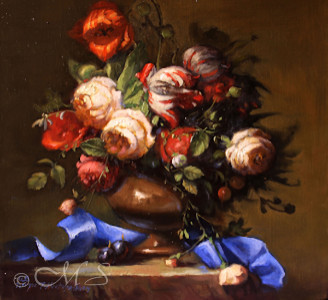
12×12 inches, Oil on Linen
© Margret E. Short, OPA, AWAM
With Additional Female Artists
NEW OIL PAINTING LESSONS PROJECT – PART III
Dancing Backwards and in High Heels, Part III: Going Medieval with Skeletons: More Stories of Mostly Forgotten Fabulously Talented Women Artists of the Past
The list of talented forgotten women artists is endless. In this series, many stories from very early times will highlight the lives of women who struggled but nonetheless persevered through cultural difficulties in order to follow their personal creative path.
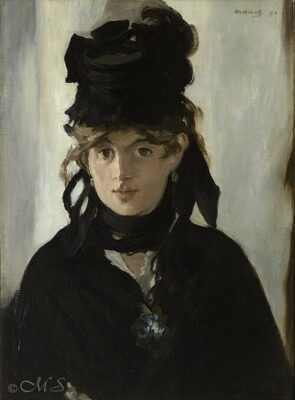
(by Eduard Manet)
1841-1895
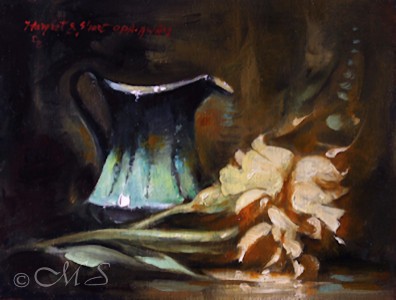
6×8 inches, Oil on Panel
© Margret E. Short, OPA, AWAM
And 9 Additional Female Artists
OIL PAINTING LESSONS PROJECT – PART II
Backwards and in High Heels, Part II: Lessons from Fred and Ginger, More Stories of Forgotten Women Artists of the Early and Current Years of Art

1823-1903
© Margret E. Short, OPA, AWAM
And 6 Additional Female Artists
OIL PAINTING LESSONS PROJECT!
Backwards and in High Heels: Lessons from Stories about Nearly Unknown Gifted Women Artists of the Early and Current Years of Oil Painting
“I purchased last week at Bronze Coast Gallery your “Chiaranzana Modello.” I love it, and I am so pleased to have a copy of the painting you used for the colors (“Portia Wounding Herself in the Thigh“) to study how you distributed the colors similarly throughout a painting nothing like the original. I hung it on a wall with a beautifully framed small enamel piece I purchased in Limoges in 1962, and they look terrific together. I have the photo of the Sirani painting on a chair below it, so I and guests can hold it up to see this unusual feature. Photos of the two have already been inserted into a “Lyle’s Year in Review” letter that I will send out next December in my Happy New Year cards. I am a very happy guy! THANK YOU!”
Lyle Tucker
Private Collector
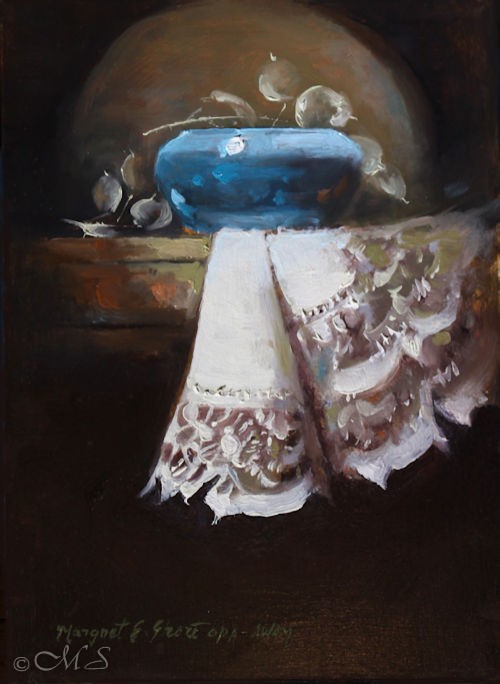
8×6 inches, Oil on Panel
Martin Hannon Memorial Award
115th Salmagundi Club
Thumb Box Exhibit 2023
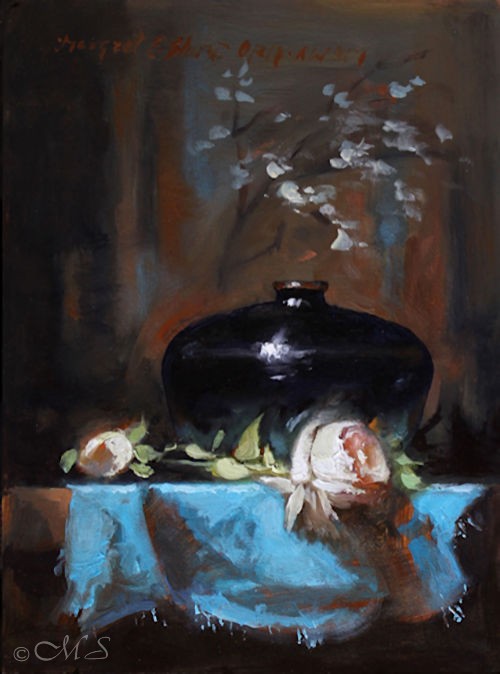
8×6 inches, Oil on Panel
Accepted for Exhibition at the Salmagundi Club
115th Annual Thumb-box
Exhibition and Sale
Skylight Gallery, 47 Fifth Avenue, NY
December 11 – January 5
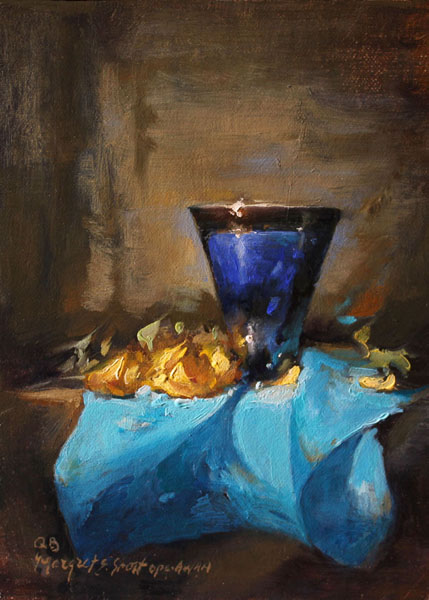
8×6 inches, Oil on Panel
Quintessential Blue: The Legendary Hypnotic Reputation of the Undeniably Favored Color of Almost Everyone: Sleeping Beauty is Not Just a Fairytale
I launched yet another pigment project using both synthetic and natural blue as a focal point in each new painting. This is in preparation for the Spring Unveiling at the Bronze Coast Gallery in Cannon Beach, Oregon where the entire series was revealed at the reception on May 6, 2023.
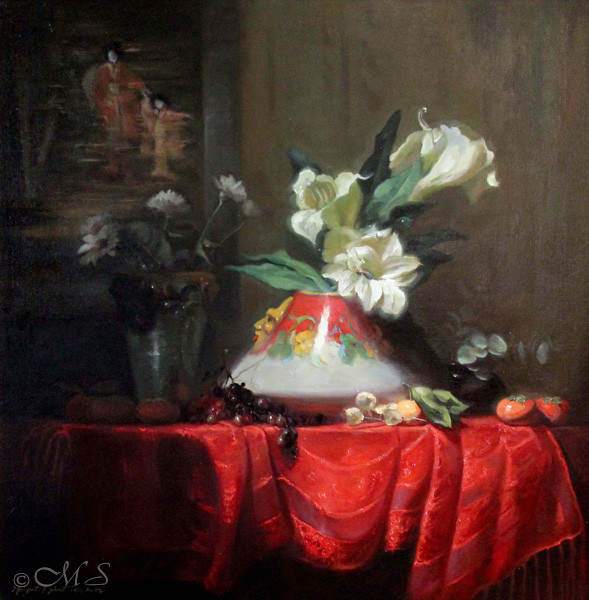
30×30 inches, Oil on Linen
American Artists Professional League Members Exhibit – First Place Winner!
Associate Members Online Exhibit
“With wonderment, Margret Short has embraced the knowledge of ancient paints and surfaces. She shares her gifts with generosity, when many artists would prefer to hold their secrets tight. Her enthusiasm when speaking of the minerals, gemstones and earth pigments, she grinds for paint and the metal surfaces she paints on transports the audience back in time. Her mastery of the medium and her beautiful “chiaroscuro” paintings have been recognized all over the world and will be a treasure to future generations.”
Diane Kruger
Owner, Signature D Art Cons
Latest from the Blog

The Final Star; A Jet-setting Angelica Kauffman
Had there been airplanes in the 18th century, Angelica Kauffman would surely have been considered a Jet-setter. Because of immense privilege granted to her, Angelica traveled and studied widely, including Austria, England, her home country of Switzerland, and eventually lived in Italy for three years. These opportunities came about mostly because of her father, Johann…
Continue Reading The Final Star; A Jet-setting Angelica Kauffman

Dancing Backwards with an Alsatian Nun in the Garden of Delights
During my research for this project, I have yet to delve so far back in history and this artist may be the most complex I have featured so far. The dilemma is having to coalesce religion, artistic skills of an Alsatian Nun, and feminism into one story about nuns, priests, and a convent during Medieval…
Continue Reading Dancing Backwards with an Alsatian Nun in the Garden of Delights

Dancing Backwards with Phoebe Moss Traquair: How to Meet Your Spouse
One innovative way to meet your future spouse – create illustrations of fossil fish for the guardian of the Museum of Royal Dublin who just happens to be a young paleontologist himself. Phoebe Anna Moss did just that and ultimately married the young keeper. Phoebe was an endlessly gifted participant in the Arts and Crafts…
Continue Reading Dancing Backwards with Phoebe Moss Traquair: How to Meet Your Spouse
“Margret Short’s still lifes radiate light with the wonderful color and drama of an American artist so skilled in the European tradition…”
Thomas Augustine
Stepping Out, Art Buyers Magazine
Projects / Lessons in Natural Pigments
“I sometimes think it’s every bit as important to let you know when people are moved by what you do…and today was one of those days. I spent awhile with a nice woman who has had a tough couple of years, and as she tried to explain to me how incredible she found your work to be, and how beautiful, she began to tear up, and as she wiped her eyes, she laughed at herself for crying over art. It was delightful. Thank you, for all that you do.”
Melisa
Bronze Coast Gallery